 devdevian
Devdevian 0.2 — Workspaces
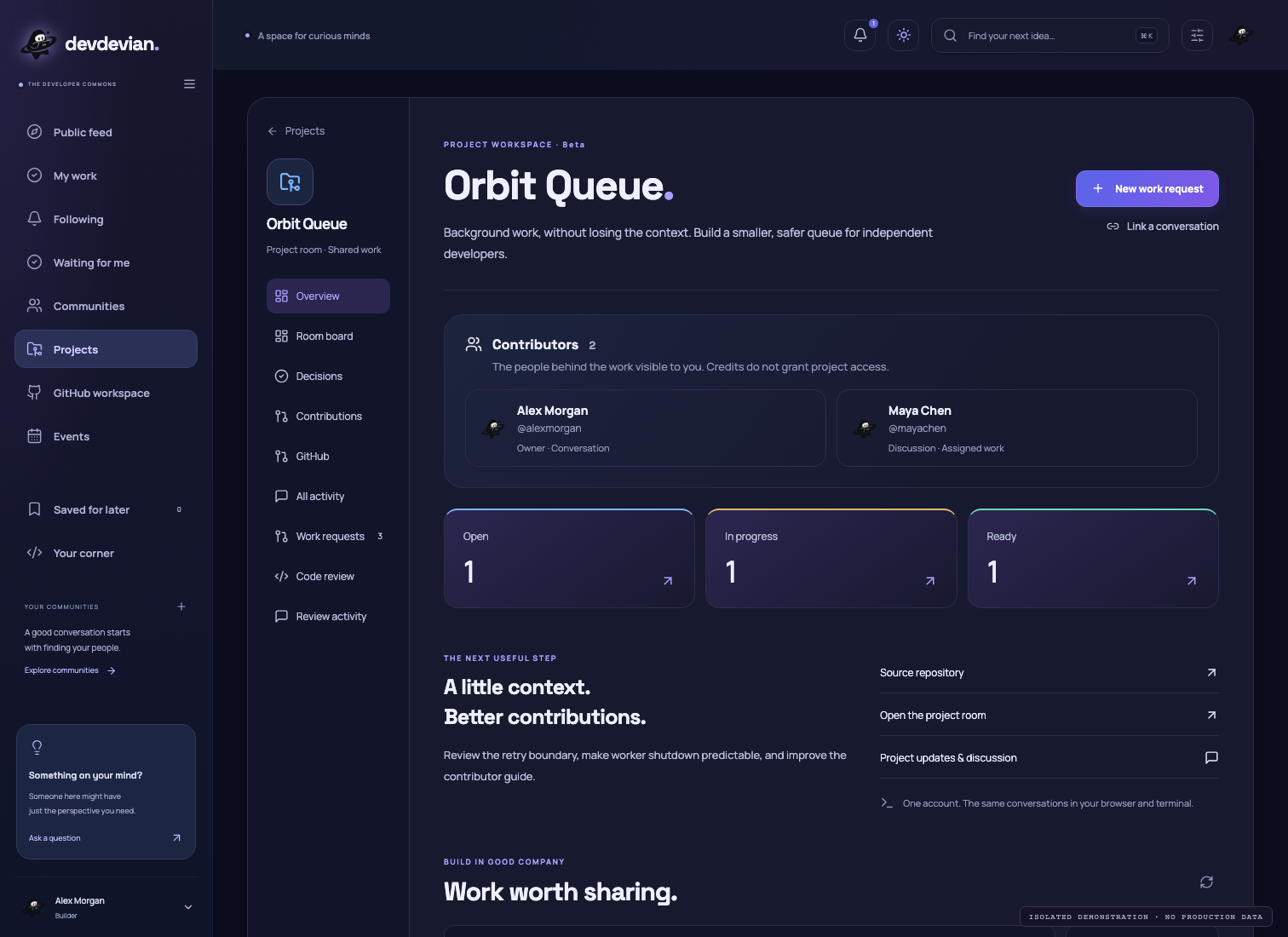
Release: browser/API 0.2.0 and CLI 0.15.0-alpha.1. Workspaces adds project requests and immutable review revisions to the real browser and terminal clients. The release-candidate audit passed; production rollout status is tracked separately from source/package versions. The original isolated visual concept remains available as a design demonstration.
Workspaces extends the existing Projects into a place to keep work requests, review iterations, decisions and activity together. The main user journey is a review that continues after the code changes, available through the browser and the terminal.
Try the concept#
npm run preview:workspaces
Open http://127.0.0.1:4180/. The isolated Vite preview listens only on loopback and uses the fictional Orbit Queue workspace. It makes no forum API or GitHub requests. All interactions live in the current page's memory and reset on reload or Reset sample workspace. It is separate from the production build entries.
Walk through Open review → add a v1 remark → Share revision v2 → compare v1/v2 → View v1 on an earlier remark → add v2 feedback. Earlier quotes remain attached to v1 and are not automatically resolved. The prepared v2 snapshot is example data; this step is not an upload or an edit to a GitHub PR.
Also try request filters/search, creating a request, replying and reopening it, changing its status, pinning a decision, marking activity as seen, Cmd/Ctrl+K, mobile navigation and the terminal concept. The terminal panel illustrates a proposed workspace view; it does not add commands to the published CLI. Its install button copies the existing alpha installation command.
Proposed product contract#
| Concept | Existing foundation | 0.2 extension |
|---|---|---|
| Workspace | Existing project ID, owner, presentation, team credits and updates | A project navigation surface and project-linked work |
| Work request | Existing conversation, kind, author, replies and visibility | One explicit project association and Open / In progress / Ready workflow |
| Review revision | Existing exact published snippet, hash and line feedback | Append-only, multi-file snapshots with stable IDs |
| Remark | Existing feedback ID, snippet hash, global range and saved quote | Explicit revision/file identity, safe navigation and version-aware discussion |
| Project context | Existing project owner and metadata | Pinned decisions with authorship and edit history |
| Activity | Existing notifications and project updates | A bounded project feed and a viewer-specific seen cursor |
Team credits do not grant private read access. A workspace does not create a second community membership system. Request and snapshot access must derive from the parent conversation and approved community membership. A public project page must not leak private requests through counts, previews, activity or search.
Revision invariants#
- A published revision is immutable. Replacing code creates another revision; it never overwrites the code a remark was anchored to.
- Store exact code, file order, selected ranges, a content hash, author, creation time and repository/base/head provenance. GitHub metadata remains author-provided unless separately verified by a reader.
- Old feedback IDs, notification URLs, quotes and resolution state survive the migration. Never infer a new anchor merely because a line number happens to exist in the latest code.
- Legacy feedback may have a saved quote without a retained full snapshot. Show that quote and label full historical code unavailable; do not fabricate old file contents.
- Counts distinguish current open/resolved remarks from earlier remarks. Sharing v2 does not resolve v1 feedback or accept a solution.
- Code comparison is a view, not the storage or identity model. The small sequence diff in this concept must not become the production anchor authority.
- Current browser/CLI clients must keep reading the latest ordinary publication. New fields and migrations must be additive; unsupported operations need explicit capability checks.
Initial capabilities#
| Action | Proposed authority |
|---|---|
| Read request/revision/activity | Existing parent visibility and membership |
| Link/manage a work request | Must own both the project and conversation; team credit grants no authority |
| Publish another review revision | Request author |
| Add feedback/reply | Authenticated reader, subject to existing paused/removed/limit rules |
| Resolve feedback / accept solution | Existing publication-author rules |
| Pin project context | Project owner initially |
| Change project presentation | Existing project-owner checks |
The prototype views the sample as its owner and does not implement these backend permissions. Moderator powers must retain their existing public/community boundaries. Revisions and private files must use the established authenticated upload/download boundary; a stored provider URL cannot replace access control.
Delivery plan — one public milestone#
- Concept: validate project navigation, work requests, repeated review, old quotes and phone/desktop use. This branch currently implements this step.
- Data contract: implemented on this branch: additive project associations, immutable review snapshots, migration/backfill, capability responses, permission checks and compatibility/recovery tests. Keep old quotes and URLs readable.
- Browser integration: core workflow implemented on this branch: real Project workspace navigation, visible work requests with search/paging/status/link/unlink, multi-file revision publication preview, original snapshot viewing and comparison, pending/error states and tab-scoped drafts. Project decisions and a dedicated activity/seen feed remain later work; existing introduction/updates/discussion links stay available.
- CLI companion: implemented on this branch: explicit linking of the current directory to an existing project, project-scoped navigation, revision preview/publication and the same version/permission rules. No automatic repository upload or code execution.
- Release candidate: multi-account/private-access tests, recovery and failure paths, migrations/rollback rehearsal, query/request budgets, mobile/keyboard checks and actual browser↔terminal continuity. Ship a combined 0.2 milestone when this complete workflow is ready.
Private GitHub repositories, GitHub writeback, arbitrary code execution, realtime collaborative editing and a new role/membership system are outside the first milestone. Workspace CLI versions remain separately versioned alpha packages; this concept does not assign a stable CLI 1.0 label.
Verification#
npm run test:workspaces checks immutable revision behavior and exact comparison reconstruction, then drives the interactive concept in Chromium. The browser scenario covers requests/replies surviving dialog navigation, revision/quote boundaries, decisions, activity, terminal selection, keyboard navigation, reset and 1440/1024/768/390/360px layouts. It asserts that no forum API requests occur. Ordinary production checks remain required before integrating the interface.
Shared API contract#
Existing Projects and conversations keep their IDs and routes. Nothing creates a second project or private-membership system. The implementation is in workspaces.mjs and review-revisions.mjs.
| Endpoint | Behavior |
|---|---|
GET /api/projects/:id/workspace | Project identity, server capabilities, owner permission and viewer-scoped counts |
GET /api/projects/:id/work-requests | Paginated visible requests; optional state and q |
GET /api/projects/:id/work-requests/:postId | Current association/version; owners can inspect the version of a detached association |
PUT /api/projects/:id/work-requests/:postId | Explicit link/relink with state and expected_versionThe version you read before editing. A conflicting write is rejected instead of overwriting newer work.; 0 only for a never-linked conversation |
PATCH /api/projects/:id/work-requests/:postId | Change workflow state with its current expected_versionThe version you read before editing. A conflicting write is rejected instead of overwriting newer work. |
DELETE /api/projects/:id/work-requests/:postId | Detach with expected_versionThe version you read before editing. A conflicting write is rejected instead of overwriting newer work.; keep the conversation and advance the association version |
GET /api/posts/:id/revisions | Paginated snapshot metadata, current_revision_id, post_revision, capabilities |
GET /api/posts/:id/revisions/:revisionId | Exact retained code, ordered files, global line ranges, file hashes, provenance and review focus |
POST /api/posts/:id/revisions | Author-only publication with expected_revision, base_revision_id, ordered files: [{path, code}], review_focus and optional github_context |
Capability responses contain work_requests: 1 and review_revisions: 1. New clients must check capabilities before offering writes. 409 means stale state, paused publication or a storage cap; preserve the draft and reload. Private/non-readable targets return 404. Project introductions cannot themselves become work requests. Detaching keeps a version tombstone so an old editor cannot overwrite a later relink. Credits do not grant access. Workflow Ready is independent of accepted answers and feedback resolution.
A revision contains up to 10 unique relative paths and 20,000 total code characters, joined by one newline in file order. Exact original line endings and trailing lines are retained. Global start_line/end_line refer to this exact flattened text, preserving the current clients' line-number contract. PR file/hunk provenance is validated against the complete supplied patches; provenance remains author-provided, without GitHub verification or writeback. Untrusted paths are labels, never filesystem reads. No repository fetch or code execution occurs.
Line-feedback lists additionally return revision_id for the current snapshot and each remark's nullable snapshot_id, snapshot_available, derived file_path and outdated. New feedback can send revision_id and file_path with the existing hash/global range; stale identity is rejected even when two revisions have identical code. Explicit-version feedback must stay within one file. Old clients can continue sending only snippet_hash; their new remarks attach to the current retained snapshot. Their hash-only stale-read detection cannot distinguish two identical texts; new clients must send the revision identity. Current/earlier counts use snapshot identity rather than only code equality.
Ordinary post creation and legacy PATCH edits also retain review snapshots atomically. A title-only edit does not create a new snapshot. Replacing code never resolves remarks or accepts a reply. Historical feedback replies, tombstones, IDs, notification links and original quotes are unchanged. A DB trigger blocks accidental snapshot UPDATEs; no API edits or deletes snapshots. An intentional data-erasure procedure may delete retained records; snapshots are not a substitute for a retention/privacy policy.
Publishing revisions is bounded to five per author per ten minutes across both APIs, and 100 snapshots per review. Project workflow mutations are bounded to 60 per author per five minutes. Lists cap pages at 30. These limits bound individual operations, not a claim of unlimited hosted capacity.
Additive migration and recovery#
This is an operator procedure for the eventual 0.2 deployment, not a request to migrate production now. Use an explicitly selected environment. The migration CLI skips implicit .env loading for both preparation and finalization; it neither reads developer credentials from a local file nor overwrites environment files. A separate fixture verifies this with deliberately invalid local settings.
- Create and verify a database/file backup. Rehearse on a restored disposable copy first.
- Run
node scripts/migrate.mjs --prepare-workspaceswhile release 0.1.10/schema 6 remains active. It creates association/snapshot tables, a nullable feedback anchor/index and an immutable-update guard. It backfills the currently retained review code in bounded keyset batches, and records readiness only when preparation finishes. The main schema marker remains 6. - Existing remarks whose hash matches that retained code gain the snapshot identity. Older unknown hashes keep NULL and their exact saved quote. No historical contents are guessed. Valid existing multi-file PR boundaries are retained; unknown file origin uses the explicit
snippetlabel. Preparation is repeatable and does not reset content, accounts, sessions or files. - Deploy the new server only after preparation completes. It accepts prepared schema 6 without running DDL/backfill on request startup. Verify the real browser/CLI workflow before
node scripts/migrate.mjsfinalizes marker 7. A premature/partial preparation fails the readiness check. - After finalization the old server will reject marker 7. Rollback requires an explicit reviewed marker compatibility step with the additive tables retained; never restore an old backup over new user activity. A prolonged mixed-version deployment may have quote-only feedback from the old server, which remains readable; avoid treating an absent full snapshot as recovered history.
The backup schema copier includes snapshot tables, anchors, indexes and triggers. The regression fixture restores that copy, verifies quote/revision identity and confirms the immutability guard still rejects updates. This verifies the storage contract locally; it does not assert that hosted backup scheduling or a production restore drill has occurred.
tests/workspaces-api.test.mjs covers ownership, private-list/search/count boundaries, revoked membership, workflow/version conflicts (including detach/relink), multi-file offsets and exact bytes, repeated-code identities, old-client edits, stale requests, paused states, revision budgets/caps, interrupted-write rollback, repeatable v6 preparation and snapshot recovery. The visual concept's separate tests still assert zero forum API calls.
Browser workflow#
Use Projects → Open workspace, or /app#workspace/PROJECT_ID. The project introduction also links to its workspace. Overview shows actual project context and viewer-scoped workflow counts; Work requests supports bounded search/paging, status changes and explicit link/unlink. Code review opens a linked review at /app#workspace/PROJECT_ID/review/POST_ID. Its Full conversation link retains all existing replies and publication actions. A linked ordinary conversation points back to its project. No placeholder decisions, activity or terminal-workspace commands are advertised as implemented features.
The request creation flow has a publication preview and explicit audience. Creating a conversation and linking it are two operations: intent is saved before POST and the published ID is kept before linking. If creation has an unknown outcome, the tab draft blocks replay after reload until the author checks their conversations; definitive validation/quota refusal allows correction. If linking fails or its response is uncertain, retry checks/reuses that ID rather than publishing again. Authors can leave that conversation unlinked and later link it explicitly. Unlinking has a confirmation and preserves code versions, feedback and replies.
Every review in the app has a paginated version history. Authors can select up to ten relative file labels, edit text, preview the exact files and publish a new immutable revision. Prior GitHub provenance remains on its original snapshot; manually edited browser revisions do not silently inherit a possibly stale commit/PR claim. Historical remarks open their exact original file/global range; quote-only legacy remarks are explicitly labeled unavailable for full-snapshot viewing. Viewing an old version is read-only. Comparison preserves both original texts/line numbers, caps quadratic work, and paginates large changes using an exact replacement view.
New feedback sends the snapshot identity alongside the existing hash/range. If the conversation changes between the code read and feedback read, commenting pauses until the current code reloads; feedback text is kept. This also protects identical-code revisions. A stale revision editor keeps its draft and can load/compare the latest published snapshot before previewing again. No automatic merge or automatic mutation retry occurs.
Request/revision/feedback drafts live in sessionStorage with account and project/post-specific keys and a 24-hour expiry. Edits persist directly in input handlers, so an immediate hard reload retains the last edit without waiting for a React effect. They survive editor closing and tab reloads, but not a closed browser tab. Only bounded text and published IDs are retained, never credentials or upload handles. Storage-denied editors remain usable in memory and display the limitation for request/revision drafts. Discard controls restore a clean request or the selected current baseline; they never delete a published conversation. Account switching does not expose another account's drafts or private requests.
The new read fields are additive: workspace identity includes existing public project context; request pages include scoped author/excerpt/reply counts and an optional kind filter. Associated public work-request identity is readable by guests; unlinked association/version inspection remains owner-only. Conversation detail includes a readable parent work_request link or null. Line-feedback reads include current post_revision and file boundaries so the browser can detect mismatched reads and navigate ordinary multi-file snapshots as well as GitHub patches.
Try it without a hosted database#
npm run preview:workspaces:app
This builds the real app, starts a loopback server and prints its URL. It creates a disposable temporary database, two sample accounts, an Orbit Queue project, an original remark and a second multi-file revision. The terminal prints sample-only sign-in details. Stopping the preview removes its own temporary database. It does not load a developer .env, inherit a cloud database or send OAuth/email requests. The existing npm run preview:workspaces remains the separate session-only visual concept.
npm run test:workspaces:app builds the app, runs model/API tests and drives the real multi-account browser flow. scripts/workspace-browser-check.mjs covers creation, drafts, uncertain-link retry without duplicates, unlink/relink, exact old code/quotes/comparison, stale-editor recovery, account switching, private/guest permissions, keyboard close and five widths in both themes. Artifacts live under ignored .test-data/workspaces-browser/. The production migration and CLI companion are still separate future stages.
CLI companion#
The terminal extends the same project IDs and APIs. packages/cli/lib/project-workspace.mjs contains local binding, bounded project reads, association plans, immutable revision preparation and two-phase creation recovery. It is separate from the existing workspace.mjs filesystem/Git picker. No repository configuration file is created; settings are scoped to origin/account/canonical directory outside the repository.
The live UI adds project request navigation, workflow filters, confirmed links/status changes, owner creation, paginated revision history and read-only original snapshots. Authors prepare another revision with the existing file/range or Git-diff picker, inspect exact code and confirm publication. Script commands also accept ordered local multi-file manifests. Existing selected-code restrictions remain in force. See the CLI guide for commands and keys.
Feedback reads check both code hash and conversation revision; writes include snapshot ID and one file boundary. Session position memory includes snapshot identity, preventing identical-code revisions from inheriting an old position. Publication uses the baseline captured before selection; conflicts retain the draft/preview and never silently rebase. Old feedback targets and notification routes remain compatible, and quote-only historical feedback stays explicitly labeled.
Request creation saves a known new post ID before linking it. A failed association retry reuses that ID; an unknown POST outcome is not replayed. Retrying an already-published request links its original content, rather than implying that later form edits changed the published post. Unlinking only removes the association, not the conversation.
packages/cli/test/project-workspace*.test.mjs covers scoped settings, explicit file selection, duplicate/secret/traversal boundaries, recovery, history, exact previews, conflict retention and compact real PTY layout. tests/workspaces-cli.test.mjs drives script commands against an isolated real API: browser feedback → CLI revision → original snapshot/old feedback, current feedback anchors, workflow changes and private access denial. Fixture checks do not replace the operator rollout procedure or establish that a hosted restore drill has occurred.
Local verification for the CLI companion: 168 tests in the combined sequential suite and 99 isolated libSQL/S3 fixtures passed. The package dry run includes the companion module; npm publication is a separate operator step. CI results are tracked separately from local verification.
Release-candidate audit#
The operator rehearsal and expanded regression checks are described in reliability and recovery. Guards now reject implicit cloud/production migrations outside Vercel, future schema downgrades, missing prepared-v6 guards/indexes and unknown/combined migration actions. Encrypted backup recovery preserves project links, revisions, old feedback/replies and private files; restored sessions remain empty and private revocation still applies. Pre-finalization rollback-era writes are re-prepared honestly, keeping unknown full-history remarks quote-only.
Both browser and CLI persist uncertain creation intent before POST, preventing a reload or killed terminal from silently replaying an unknown outcome. Known published IDs remain separate from link retries. Browser tests also confirm that a definitive quota refusal unlocks editing without losing text.
The expanded load fixture exercises project/revision reads and private aggregates alongside existing feed/feedback endpoints. Production migration/deploy and package publication follow the operator procedure; a combined GitHub release is recorded separately. Existing decisions/activity concepts remain outside the implemented core; this audit does not advertise them as shipping features.
The final local audit passed 173 tests, 103 isolated libSQL/S3 fixtures, the expanded responsive browser workflow and the bounded load fixture (300 reads / concurrency 10 / zero errors). The encrypted restore rehearsal uses fictional fixture data; hosted restore/deployment and package publication are not implied by these results.